Skip navigation

Category Archives: Uncategorized

The Project:

One Mustang directly off the range, One trainer, No tools, Just body language

The Goal:

To discover how far Equestrian Art can be developed solely using body language.


Ransom “aka High Tech Exec”

Ransom was dapple grey, leggy and lean. Ransom was my first Thoroughbred. As with most of the horses in my life, I didn’t choose him with any forethought; circumstances simply arranged themselves in such a way as to bring the two of us together for a time. To this day I cannot believe my good fortune to have had him as a partner and teacher.

Ransom started his life as a racehorse. As a racehorse he was well bred, well cared for, and well loved. When a bowed tendon made it clear he was ready to be retired from the world of racing, my dear friend Rikke stepped in to bring him through his life change.

I will admit, I was jealous. Thoroughbreds are such sleek powerhouses of grace and speed. All through my childhood filled with adorable chubby ponies, I would gaze longingly after the riders sitting high atop their long-legged, elegant, thin-skinned, hot-tempered horses. “Fritz and Beautiful Horses” was a story I always felt close to growing up.

Here I was twenty- two years old, graduated beyond my fuzzy ponies and now riding my beautiful Warmblood cross, Zohari, elegant and long-legged too in his own way. The lure of the Thoroughbred still sung through me though, a desire not to be quelled. So when my friend Rikke found herself needing to move back to her home country of Denmark, and Ransom needed a new home, I was beyond thrilled to be that home for him.

I think the greatest thing Ransom showed me was a style of herd leadership I had never observed before. He was a leader in our herd, and gained that leadership in a way that is still to this day a huge inspiration to me.

Ransom was not a kicker or a biter. He did not seem to need disciplinary action as any part of his dominance. His dominant role in the herd was in part thanks to his intensely vibrant personality: watching him arch his neck and float across the ground to meet someone new was awe inspiring. It was also due in part to his phenomenal persistence in winning over his herd mates.

We had a black Arabian mare named Shameeka who was not impressed with Ransom’s winning personality. When Ransom would waltz over to see her, she would pin her ears and walk away, not in the least impressed with his overtures of friendship. Ransom was not daunted, he just followed her, ears pricked, attention focused. She would sometimes squeal and kick at him, and he would just move slightly out of range and then follow again. Eventually she would become curious: what was he still doing there tagging along behind her, ever present regardless of her antics. As Shameeka would turn to look at him he would look away nonchalantly and wander off. She would lose interest, go back to grazing and he would snap back to attention, following her ceaselessly until her curiosity was piqued again. It took him three days of persistence wherein, little by little, Shameeka became more and more interested. By the end of those three days she was completely devoted and followed him everywhere.

It blew my mind to see one horse win over another with so little violence. It also made me realize, while we talk about natural horsemanship and learning to understand and communicate the way horses do, there is a broad spectrum of skill in communication via horse language, just as there is via human language. Ransom was a master of positive communication.

Outside of his herd skills, he also had a self-awareness in movement that was sensational. He could canter like a rocking horse, or stretch out and gallop with speed that took my breath away. Everything he did, you felt as though he had thought about it and decided it was indeed what he wanted to do. When I would shake the rope at him to back up, he learned that he could back up a few steps then take the rope in his mouth and shake it back at me. Turn about is fair play after all. I would laugh so hard and back away just as he asked. Working with Ransom was the best laughter therapy. For all the things I thought to teach him, he was right there with me to show me things I had never thought of along the way.

Polocrosse was Ransom’s game. He was unbelievable. At our barn we play polocrosse with only a string around the base of the neck to guide them. That way you really get a sense of how much your horse wants to play the game. Ransom thought galloping and turning and jostling for the ball among six horses was great fun. However he had little patience for my lack of ball skills. We would canter up past a ball on the ground and I would miss the pick up. Ransom didn’t have to be told a thing; he would wheel around and place me right on top of the ball again. More often than not, I would miss again and Ransom would spin about to give me another chance. Chances were not unlimited though. At some point, if I missed the ball to a degree he thought unseemly, he would put on the brakes, screech to a halt, and turn to look me in the eye as if to say: If you don’t pick up the dang ball, we can’t gallop to the other side of the field, so pick it up already!

Ransom was a horse that made me laugh, everyday. Unfortunately, he is no longer with us. In 2006 I moved to Norway for family reasons and Ransom became partners with my good friend Jenny. The two of them lived, laughed and rode together for a year, and then in a fluke accident one snowy day in the pasture, Ransom broke his leg and had to be put to sleep. He is missed by many, though I would like to think his legacy lives on in all he taught us. He was an inspiration to me in so many ways and I hope I can bring his sense of joy to the art of leadership as I befriend horses throughout the rest of my life.

Thank you Ransom. You gave me an immeasurable gift.

Elsa Sinclair

www.equineclarity.com

The Project:

One Mustang directly off the range

One trainer

No tools

Just body language

The Goal:

To discover how far Equestrian Art can be developed solely using body language.


Patience

I once heard a very amusing horseman share this, and it has stuck with me ever since.

You only need three things to train horses. The first, is patience. If you run out of the first thing, the second thing is… more patience. Then if you find you have run out of the first two most important things for training horses… the third thing you need… is more patience.

It often occurs to me, as I am walking through any relationship, how unbelievably patient we all need to be with each other. Part of the fun of a relationship is being unreasonable in our expectations. When someone asks me to do something I don’t think I can do,  I often find that, for them, I will try anyway. When I come out the other side of that challenge, I find myself bigger and better than I thought I could be. I think horses are the same. We ask things of them all the time that they are not sure they can do. Yet every time they do something new successfully, their self-confidence changes, hopefully for the better. What makes that change in confidence positive or negative? I believe the difference comes down to patience in the training process.

Wikipedia states:

“Patience is the level of endurance one’s character can take before negativity. It is also used to refer to the character trait of being steadfast.”

Parelli talks of the three stages of learning: Mental, Emotional, Physical. First we must mentally understand the task, then we must become emotionally comfortable with it, then we can physically develop what we learned.

Mentally: We ask a horse to try something new with pressure, release and reward. If we get the timing right, they mentally understand the task.

Emotionally: To build skill we need to have the fortitude to practice. The patient repetition, is the art of practice. Emotional stamina, or patience, is essential in building a skill.

Physically: Once a skill is comfortable, only then can we build or improve on it.

Without patience to develop skill, we often end up seeking more excitement than we are ready for, attempting to add challenge after challenge on top of new, barely learned, skills. This leads to the stress of too much challenge and not enough skill.

All this came to mind as a necessary balance after the last blog I wrote. I wrote about limited available time, and speeding up the process of relationship building and bonding between horse and rider.… In an ideal situation, I think I wouldn’t try to speed this up; I would just take the time it takes. I would be fully patient with the process, building relationship simply out of attention and attraction.

However, I have set this up as a year long challenge for myself, so there is the desire to move training along with some efficiency. As well as perhaps a slight addiction to pushing myself out of my comfort zone and making things just a little more challenging than my skill level, giving me the excitement of having to grow faster.

Having admitted my tendency to impatience, I would like to make every effort to balance my push for progress with staying grounded in a commitment to meditative, patient practice.

Parelli suggests the guidelines of 80% consistency, 20% variety. I like that idea. For every 20% of the time I play with speeding up the process, I need a balancing 80% spending time simply getting comfortable with what we already know.

This project I believe will let me know loud and clear when I need more patience. This horse will need to be truly comfortable with the skills we develop together. If this horse gets uncomfortable or impatient, there is not much stopping him from walking away. Pure and simple, I will need to hone my patience in order to develop my horse’s patience.

If we can have the patience to build skill one solid step at a time, then everyday we will find ourselves living within a larger playground of skills.

Sounds like fun to me 😉

Elsa Sinclair

www.equineclarity.com

The Project:

One Mustang directly off the range, One trainer, No tools, Just body language The Goal:

To discover how far Equestrian Art can be developed solely using body language.


Developing the bond


I wrote about Attention, Attraction and Emotion a few weeks back. Now I want to look closely at the beginning baby steps of emotion- creating a bond between this horse and myself.


When the new mustang arrives on the project in August, Attention and Attraction will be where it all starts. That is, I believe, the first piece of the puzzle. Then the question becomes: how then do we build the emotional bond between horse and rider?


Once I use attention to draw the horse to me (attraction), I would then, in the conventional approach, put the halter on. As that is not part of this plan, the question the horse might ask becomes: now that I am here, why do I want to stay with you? If I leave why would I want to come back?


In an ideal world the answer would be: because we are partners, a herd of two, and it feels natural and comfortable to be together. The more time we spend together the more of a habit it becomes to be close and the more of a bond we develop.


In an ideal world I would go with that answer and take the time it takes to develop that kind of a pure bond with my horse.


In the world I live in, I don’t have that kind of time. My time must be divided between many responsibilities each day. So how can a close bond form within the constraints of my available time?


Often people will use a rope or stick or fence line to add pressure when the horse chooses to leave, so that way there is a stark contrast when the horse remains bonded and attentive to their human partner- it feels safer and easier than the alternative. Without rope or stick, and a desire to leave all the fence lines out of this conversation… I must look for other solutions.


I considered keeping the horse by itself, ensuring the relationship I offered would appear that much more valuable. That idea was quickly discarded. This horse needs to offer me partnership, not be forced into it by desperation for companionship. So, if this horse will have a herd to live in, it has companionship, partners and a family already. Why would it want to join up with me?


In the interests of time, here is one idea I have come up with. In the wild environment, resources such as food and water are claimed first by the leaders in a herd, shared with the others when the leaders are ready to share. I believe that is an aspect of natural life I can take advantage of. While I don’t have the time to impress this horse with my leadership qualities just by the power of my personality, I do have opposable thumbs well suited to opening and closing access to food and water.


I am aiming to keep this process as natural as possible, therefore, I must keep food available at all times. A horse’s stomach is designed to be digesting food all the time. Even when there is no food, the stomach continues to produce stomach acid, which in the absence of food can create ulcers, a common problem in domestic horses. In the wild there may not be much to eat, but there is always something to browse on. In my endeavor to keep things natural I will make sure this horse has access to slow feeders with simple grass hay 24 hours a day.


That leaves me with water. In the wild, water is something that is traveled to. It isn’t always available. If I put myself in the position of being the herd leader that brings the horses to water a few times a day, I believe I may be able to speed up the bonding process. I also can be the one to bring them to salt, minerals, and supplements- nourishment that is special, above and beyond the simple forage always available.


So my plan is to start with attention, build to attraction, then develop the bond between us as I consistently show the horses my leadership is something well worth having.

It’s exciting thinking about all this: within one year of training, using only the pressure my comparatively small body can wield,  to somehow convince a horse completely new to the world of humans, that I am a leader worth following, and a partner worth exploring the world with.


However much we do or do not achieve together over this year of experimental training, I think the process will be a life changing one, for both of us.


Elsa Sinclair
www.equineclarity.com

The Project:

One Mustang directly off the range, One trainer, No tools, Just body language

The Goal:

To discover how far Equestrian Art can be developed solely using body language.

When time gets full, and seems more work than play. I start looking for inspiration. This week’s blog is just a little fun. A visual inspiration. I want my life with horses to be this much fun…. More play, less work 😉

Elsa Sinclair

www.equineclarity.com


The Project:

One Mustang directly off the range, One trainer, No tools, Just body language

The Goal:

To discover how far Equestrian Art can be developed solely using body language.

Zohari

I think it’s time for a story. Where I am today is due in large part to the phenomenal teachers I have had along my path. My human teachers have, of course, helped me immeasurably; however, it’s the horses I feel I need to write about first.

I have heard it said. “Words don’t teach, experiences teach.” A hard concept to swallow when I, in daily practice, am a teacher utilizing words to school my students. If indeed I believe that concept to be true, all I can do is use my words to set up opportunities for life to be experienced in new and enlightening ways.

Horses are the pure experience, without the words. They are the ultimate teachers of horsemanship.

This story is about Zohari: a horse who could never say no to me, a horse who gave me everything he could give everyday, a horse who gave so much of himself away that he lost all self-confidence and propelled me into the world of Natural Horsemanship. When he lost his courage, I was told I should sell him and start again with a new horse. Instead I chose the path less traveled and became a new person to partner my horse who needed a new start himself.

Zohari stands sixteen hands tall, with the lightness of his Arabian sire, the strength of his Westphalian grandsire, and the lanky build of his Thoroughbred granddam.

Zohari’s sire, Zorro, was bred to a Wesphalian Thoroughbred mare named Harmony. Zorro had been entrusted into my family’s care when I was young. My mother eventually couldn’t stand to see him kept alone, as stallions are in the world of captivity, so, to improve the quality of his life, he was given a couple of mares, the family he had never had. Harmony was one of those mares: a well bred Warmblood whose overall form had not met the expectations of her breeder. Passed from home to home, she had ended up with us. I had my apprehensions about breeding her; my mother knew it was the right thing to do. Again, I have to admit, she was correct. Zohari pulled out of his gene pool all the best traits and put them together with a harmony his dam had managed only in her name. Zohari was beautiful.

Perhaps Zohari’s emotional tendency to apprehension started when he was born. That night Harmony was still in the pasture with Zorro, the stallion. They were great friends, however, Zorro, had never seen a foal born, and with no one around but them that night, his curiosity and interest in the baby drove Harmony to be intensely overprotective. Not allowing her foal away from her chest and protectively bared teeth, he was unable to nurse, and she kept him moving away from the stallion as much as she was able until we arrived in the morning to put things to rights. Once we took the stallion away, she settled, let her baby nurse, and proved to be a wonderful mother.

Zohari, was a dear sweet foal, but never the bravest. All the babies we had had up to that point had enjoyed going out on the trails loose to travel alongside their mothers and explore the world. Zohari joined his mother for one trail ride only, and then decided that was enough for him. From that point on when we would take Harmony to the barn and out on the trail, Zohari would contentedly say goodbye at the edge of the herd and stay with the other horses until she returned. He always seemed composed and accepting of whatever happened around him. Weaning was smooth, and he became part of the boys herd with his brother and sire. The three of them led their coltish existence happily, though I am not sure Zohari ever realized he was substantially bigger than his sire and older brother. When they played he would give ground more of the time than not.

I started Zohari under saddle at three, smoothly and easily. When he had his basics, we began Three Day Event training. He was powerful over fences and hated to touch the rails, so he jumped clean and easy. I was in heaven and thought I had won the lottery. We galloped round a beginning novice course when he was four and, though he hesitated at every fence, when I asked him, he always said yes. His natural tendency to obedience made Dressage patterns a joy to train. His hyper carefulness of rails made stadium jumping feel safe and fun.

Our trainer at the time suggested it was time to get him jumping height, while he was still young enough to think he was invincible. She said he wasn’t really strong enough to jump four foot fences easily, so the idea was to gallop at them so fast that our momentum would carry us over. It was thrilling, and, if I said go, he did his very best. The winter he was four we did an indoor jumper show, showing at three foot six and three foot nine. The warm-up arena was so crowded it felt like entering the freeway at sixty miles per hour. You had to see your spot in the ring coming, and jump from halt to trot to get in. Zohari rose to the challenge and did everything I asked. This was to be our first experience jumping indoors. The sight of the solid walls behind every fence backed Zohari off significantly. He jumped the course slowly, and with such hesitation that everyone in the stands was sitting on the edges of their seats, clucking encouragement as we approached each fence. For me, and for them, he jumped them all, in spite of his apprehension.

The year Zohari turned five, everything changed. He had tried his heart out for me. I was ambitious and no matter how hard he tried, I always wanted more. Little by little he started showing his apprehension more obviously. Spooking at objects and leaping away from things became daily occurrences. I rode with a strong hand and a strong leg, with the aim to get him more focused on me and less concerned with the world around him. I tried spurs and drop nosebands and different bits to gain control over him and his fears. One day, headed out to the trails, he finally could take no more. We were traveling down the shoulder of a country road. Something bothered him and I tried to push him past. Instead of giving over to my strong leadership as he had in the past, he reared straight up and spun around, bolting for home. There was nothing I could do to slow or turn him. As we galloped flat out down the yellow line in the middle of the road I tried every trick I had, to no avail. Only once we had reached the safety of the barn would he slow. I was shaken and I don’t remember much after that, though knowing me, I am sure I lead him back out there, along that road on foot, with me in control on the ground, and I imagine I was not kind to him in my desperation to feel safe. From then on it went from bad to worse. The far end of the arena became an area to bolt from; every spook threatened to take us all the way back to the barn. Our riding gradually became limited to the side of the arena closest to the barn while I worked determinedly to build control back into our relationship.

At about this time, my wonderful mother did something extreme. She felt our horses needed a more natural life, and she informed us all there were to be no more bits in the horse’s mouths, and no more shoes on their feet. It was up to all of us to figure out how to make that work. I struggled on with conventional training for a time, attempting to do my dressage and gain control of my explosive horse with only a sidepull hackamore. Eventually, I had to admit it wasn’t getting any better. I had to find a different way.

Sus Kellogg came to my rescue. I was willing to try anything at that point. I was not willing to give up on Zohari, and I was frustrated that everything I had learned up to that point was not helping us. Sus insisted I quit riding for awhile and develop the ground work. I wanted to know how long it would take to complete this magic Natural Horsemanship stuff so I could go back to my Three Day Eventing and reclaim the Zohari I had known before he turned five. All Sus would tell me was in three months I would be really pleased with our progress.

Those first three months were rough going. Zohari was afraid and reactive to everything. I was frustrated and wanted to hurry the process along. Nonetheless, we took a day at a time and did the best we could. When we started riding, Sus insisted I ride bareback as much of the time as I could. I hated it. Zohari was always abruptly slamming on the breaks throwing me onto his withers, or scooting left or right leaving me to grab desperately on with my knees. The loose reins of freestyle riding seemed absurdly challenging on a spooky horse… yet, the process worked its magic, and, little by little, Zohari found his stability. When a horse makes a deliberate choice to be your partner, it’s a different feeling. I will never forget the day I was riding Zohari bareback and started to slide a little to one side. Instead of getting rattled as he would have before, he steadied, and hunkered down to step underneath me, putting me squarely up on top again. A movement so deliberate and focused, was something I had never felt from any horse.

I have loved this horse from day one, yet this was an action I had never expected from him. While he had always tried to do what I asked of him, taking the initiative to look out for me was a whole different world. It proved to me this was a way of being with horses that, once tasted, I couldn’t get enough of.

Over the next few years we developed our partnership to include liberty work and bridleless polocrosse. Jumping and trail riding with a whole different perspective: one of building his confidence, not just getting the job done. Passing our level three Parelli assessment test allowed us to revisit dressage with a whole new sensitivity. Performing in front of large crowds challenged us to new levels of confidence. Step by step Zohari and I grew into new versions of ourselves, and I am forever grateful to him.

Elsa Sinclair

www.equineclarity.com

The Project:

One Mustang directly off the range, One trainer , No tools, Just body languageThe Goal:

To discover how far Equestrian Art can be developed solely using body language.

Attention, Attraction and Emotion

When I was in High School, someone wise once said to me, “There is nothing more attractive than attention.” My life so far has seen that proven true time and again.

Any good relationship, including one with a horse, should start from a base of attraction. So how do we cause a horse to want to be with us?

Attention.

When I first brought Saavedra home, my wild mustang mare only four days in from the range, we tested that theory of attention and attraction and it surpassed all my expectations.

As I prepare myself for my new Mustang, and this project of challenging the “normal” course of building a relationship with a horse, I find myself looking deeply at the base structure of what makes a relationship work. Studying psychology and relationships, human and equine, I keep coming back to the idea that the relationship with others is interdependent with our relationship to ourselves.

What if the most important task in this life is to pay attention to ourselves and our emotions, then to pay attention to those near and dear to us, letting actions blossom out of that awareness. It could be as simple as noticing where my body is in space and where the horses body is in space, and how we can physically interact with the most harmony. It could delve deeper into how I feel as I stand here, how my horse tells me he feels as he stands next to me. If I have no rope to hold him to me, and no stick to threaten him into obedience to me, I had best study what would cause him to want to be with me as we learn together.

The quote that heads my blog is an intoxicating statement of what life is about for me.

“Instructions for living a life. Pay attention. Be astonished. Tell about it.”

Life is incredible, and astonishing, and beautiful, and sad, and painful, and hard, and joyful, and bleak, and blissful, and any other adjective you can think of- life is that too.

I was once diagnosed with bipolar disorder, so perhaps I feel the extremities of emotion more than most. Perhaps that is why I strive to understand how the horse feels, and help him feel better with me at every turn. I have never chosen to go the route of medicating my condition because I couldn’t imagine life without the incredible highs. Instead I have done my best to study and understand the psychology behind the roller coaster of emotions life takes us on. Enjoy the highs, and hang on tight to the knowledge that everything changes and nothing lasts forever, when the lows hit. I believe the more I can understand and help myself, the better I can understand and help my horses. We are all in this together.

There’s an old axiom: “What you can feel, you can heal.” If I want to be healthy and strong and the best of myself, I want to feel everything, and learn from it. I will admit, from where I stand that is often overwhelming. When overwhelmed, all of us come up with coping mechanisms- ways to shut down and protect ourselves. Mine has always been food, or lack of it. When that churning, nauseating, gut-wrenching, emotional pain would hit, I could dull it with enough food to sink a ship and get on with my life; or I could embrace the pain as inescapable, hopeless despair and eat nothing. Since I was a teenager I have oscillated in weight depending on how much I was willing to feel my life and how much I was overwhelmed and felt I had to shut down those emotions to survive. My weight has been as low as 118 and as high as 178.  Thankfully, for the most part I have stayed in the middle of that range, and every year I feel I can be a little more me without shutting down, a little more aware of the emotional patterns and how to learn from them.

Horses have been one way for me to step out of my own skin when I am overwhelmed by what I feel. Relationships can be a blessing that way. When my own emotions are too intense and I need a break, I can take a step back, pay attention to my horse, watch, listen, and feel what is going on with him. My horse is often my mirror. I can see for him what he needs to do to feel better, then take my own advice and apply those actions to myself. Does my horse need to move, does he need to be still, does he need to yield, does he need to breath, does he need to be close to me, or is it better to have us at a distance from one another. Whatever I see that he needs, usually is powerful in making me feel better too.

The better I feel, the more attractive I become as a partner. The better I cause my horse to feel, the more he will want to be partnered with me. I believe there is no pinnacle, ultimate, or limit on how good one is able to feel. Here again I think we can come back to Csikszentmihalyi’s chart. The more developed our skills become, the greater challenges we will be inspired to take on. Conquering the challenges leads us to higher skills and so on…. Its just important to keep the basis of relationship in mind throughout.

Attention creates Attraction which causes partnership. Emotions cause Actions and Actions let us conquer Challenges. Conquering Challenges creates Skills. If we pay attention to Emotion, it lets us know if we are focusing on the right challenge for our current skill level.

The logic is beautiful, living the emotions can be more than we know how to handle sometimes, for both horses and humans.

It’s worth it though.

It snowed almost 6 inches this week. Playing with Saavedra at liberty the last two days in the sun and the snow with all these ideas fresh in my mind… Saavedra offered me partnership I have never been offered by any horse. I have always been a slightly domineering trainer, valuing control and obedience in my relationships with horses. I have always longed for horses who would gallop to be with me of their own volition, not because of threat or the lure of the grain pan. Relationships built on control and obedience have not brought me that kind of enthusiasm.

Thursday evening, I walked out into the paddock. Saavedra was in the woods, on the other side of the arena. She picked up her head when I ducked under the fence, and then, with a beautiful abandon, galloped flat out through the woods, across the arena, and into the paddock, all the way just to see me. All I could do was stand there and grin. She wanted to be with me, pure and simple.

Attention is powerful, Attraction is beautiful, Emotion is enlightening and Actions speak louder than words.

Elsa Sinclair

www.equineclarity.com

For more information on Shitani visit OrcasFeatheredHorses.com

The Project:

One Mustang directly off the range, One trainer, No tools, Just body language.

The Goal:

To discover how far Equestrian Art can be developed solely using body language.

Why Natural Horsemanship?

When I began my journey into Natural Horsemanship under the guidance of Sus Kellogg, one of the first things I asked was, “How soon will I be back to my jumping, dressage and three day eventing?” The only answer she would give me was, “In three months, you will be really happy with your progress” It wasn’t the answer I was looking for; it was, however, all she would tell me. She was correct. After three months devoted to Natural Horsemanship with my horse Zohari, there was no turning back for me. The high I got from this way of being with horses was beyond anything I had ever known how to access intentionally. No matter the style of riding or training, there are highs and lows to everything. With the conventional training I grew up with, I usually felt at the mercy of luck. Some rides were magical, some were miserable. The magical rides kept me coming back for more, fighting through the rough days, hoping, as my skill increased, my proportion of perfect rides would start to outnumber everything else.

We all have our own reasons for spending time with horses. I often question my reasons at this time of year, as I slog through the muck, groom endless sand out of my horses woolly coats, bow my head to the wind, and laugh into the drenching rain as I stubbornly ride through the elements. Why do I do this? Is there really enough magic in this relationship to draw me out there with the horses again and again?

Yes, the answer is unequivocally yes. There is nothing on earth that makes me grin like horses do.

Horses make me feel stronger and faster than I could ever be on my own. That has always been the draw for me. As a child they let me run faster than my own feet would carry me, and they let me jump higher than my own drive could propel me. The only trick was convincing them to lend me that strength and speed, to give themselves over to our partnership. Sometimes they did and it was magical; sometimes they didn’t and it was….. anything but magical.

My natural inclination toward speed and power led me to love jumping, and later endurance riding. The determination to find more consistent partnership skills with my horses led to intense study of Dressage, and later Tellington Jones Equine Awareness Method and Centered Riding. Of all the disciplines I have studied… why Natural Horsemanship now?

It is only through Natural Horsemanship I finally feel I have a language to explain and understand the best parts of all the horse disciplines I have studied. Through Natural Horsemanship I now can see the steps and progressions people and horses travel through. It makes sense in a way that puts those magical rides accessibly in my experience day in and day out. It isn’t luck anymore; I know exactly how to find that Flow and drop directly into the Zone with my horses. Of course there are days when I don’t, but even when it is difficult, it doesn’t feel like random luck anymore. Now I usually can see the cause of a rough ride, step back and learn from it. That is what Natural Horsemanship has given me.

There was a day when all I wanted to do was run and jump. Now I find myself entranced with the question, what would cause a horse to want to run and jump with me? What would cause a horse to WANT to do anything with me?

What are the principles behind partnership? Can I see the process, and the evolution in every step, in every moment, in every breath…..

That is horses for me now. That is what Natural Horsemanship has given me. I still love to run and jump with my horses it just has deepened beyond that to include developing the will, and the desire, above and beyond the simple execution of action.

I do not consider other methods of training horses “less than” Natural Horsemanship. Any method that brings people and horses together with any degree of joy is beautiful in it’s own right. Natural Horsemanship has just given me an understanding of the underlying basis of relationship between horse and human in a way I am forever grateful for.

Natural Horsemanship has given me the tools to attempt this project. My hope is that I now understand the principles well enough to move beyond the status quo, to take the building of relationship between horse and human beyond training pens, ropes and sticks. To break it down to the bodies in play, and see what we can do together….

Here is to the beauty of simplicity, the power of horses, and the joy they bring us every day, rain or shine….

Elsa Sinclair

www.equineclarity.com

The Project: One Mustang directly off the range, One trainer, No tools, Just body language

The Goal:

To discover how far Equestrian Art can be developed solely using body language.

“Emotion in motion”

I believe what we FEEL is the greatest driving force for what we do. Our emotions become our motion through life. And then our motions feed our emotions. It is an interconnected cycle.

I talked about Csikszentmihalyi’s chart a few weeks back, and the beauty of understanding how our emotions can give us insight into where we are standing in the range of our challenges and skills.

Today I want to talk about cause and effect. How do we cause a horse to move in such a way that he feels increasingly better? How do we cause a horse to feel increasingly better so he chooses motions that improve his life?

If we as humans can have a part in this developmental process with the horse, I believe it has an unbelievable bonding affect between horse and rider. The better a horse feels in his own body and the more he connects those positive feelings with his partners in life, the better partner he becomes.

We all know what it feels like be so emotionally distraught, the stomach becomes tied in knots, churning in anguish. It is an emotional feeling, that becomes a physical motion of the intestines. When horses become caught up in those emotions, the motions of their bodies can become dangerous, with their intentions aimed in self defense, far from the partnership we seek with them.

Klaus Ferdinand Hempfling’s work with horses is some of the most thought provoking for me when considering the links between emotion and motion.

If we consider the way emotions can tie the stomach in knots perhaps motions that address the physical movements of the stomach can in turn change the feelings behind the movement.

When we feel self defensive, we brace against the threat. Often the more we brace, the tighter we feel and the tighter we feel, the more defensive we get.  If instead we learn to yield and soften from the threat, perhaps the defensiveness will dissolve, and partnership can evolve from there.

The Tao To Ching states:

Stiff and unbending is the principle of death.
Gentle and yielding is the principle of life.

Thus an Army without flexibility never wins a battle.
A tree that is unbending is easily broken.

The hard and strong will fall.
The soft and weak will overcome.

In the work Klaus does with his horses, there is nothing weak about it. However, notice the yielding nature of the flank area as the horses move. I believe that yielding in the flank is a powerful way to access and positively develop the emotions with a horse. As they become soft through their mid section, they literally feel better. Physically and Emotionally

Time and again I have come across variations of this idea throughout all different horses training methods. Working with Dominique Barbier studying Classical Dressage, we did endless working in hand before riding. Working with Linda Tellington Jones Equine Awareness Method, we learned ways of moving the horses body in non habitual movements to soften the belly, and release tightness in the flanks. In Centered Riding practice we learned to read softness of the flanks, the deepness of breathing and resulting stretch of the top line as signs we were starting to get our riding form correct. In the Film “In a Whisper” Josh Lyons wins the mustang training event after what seems like hours of modified disengagement. He addresses that softness in the flank very directly and you can see it pay off. Pat Parelli says that improving your sideways and backward will improve everything else you do. A friend of mine who was having some horse aggression challenges in the stable, mentioned the other day that everything was going much better once the horse started being worked with more focus on the lateral work in her dressage. Even in the most basic gut-reflex varieties of horse training, I have often heard people say, “don’t you dare swing your butt towards me, that’s rude!”

It is not just rude for a horse to swing his rump into your space, it is a clue to you about how he feels in his gut, what his emotions are doing to him. It is simple instinctual self defense. All the horse wants is to feel better.

I believe, if we can teach a horse to yield softly through the flank, we give him tools to feel better.

This is an interesting demonstration of that by Klaus. You can see the horses brace and tightness in the flanks as he is emotional and upset. Watch Klaus yield his horses flanks back and forth until they can settle, find confidence, and move on in harmony.

http://www.youtube.com/watch?v=GNXddsvAjOc

Klaus uses his ropes and sticks and training pens minimally compared to most horse trainers. His horses seem happy, connected and perform at a high level of skill. The work I will be doing in this project, with my Mustang, will be different. However, I do believe the softness and yielding in the flank will be a strong base and building block of our relationship.

Working without the tools I would need to control the horses body after the emotions have driven things out of hand. I must seek first to develop the emotional stability of the horse. Causing him to feel comfortable in his own body. Which I believe will cause him to make choices serving the best interests of our partnership. If my horse always acts like a partner, I have little need for external tools to control his physical actions.

I am deeply grateful for the clarity and beauty Klaus has brought into the horse world with his work. He is an inspiration to many.

May our emotions cause us to dance, and may our dancing bring us joy. 😉

Elsa Sinclair

http://www.equineclarity.com/

The Project:

One Mustang directly off the range, One trainer, No tools, Just body language.

The Goal:

To discover how far Equestrian Art can be developed solely using body language.

“Elsa’s Herd”

The plan is to adopt a new Mustang. A wild horse, fresh off the range, as natural and untouched as is possible. I have an idea of what it might look like  to develop a riding partnership with a horse, using only body language, no tools of force. I would like to test the validity of my hypothesis with a partner who has not yet been habituated to human requests. A partner who will act like a horse and give me responses untainted by previous human interaction. A horse that will act like a horse, and respond as a horse would respond, unfettered by any previous understandings of human expectation.

The original plan was to spend a year building up to this. Write, meditate, and walk through potential processes with horses that do already know me. Ease myself into this challenge with the help of horses that already trust and respect me. With some careful thought about the process of documentation, I am leaning toward starting the process earlier. Basing plans on my projected year of documentation, if I start with my new Mustang partner in August, then I have some beautiful fall weather to take pictures, and video of the very beginnings. Following that, I will have the winter to work slowly and thoughtfully between rain storms. Perhaps by spring I will have built a strong connection and be ready to make the most of the glorious spring and summer weather in the San Juans with my new Mustang partner.

That leaves me with six months left to prepare, play, and contemplate the challenge. This blog entry is about a few of the horses who are doing their best to educate me.

Four mares live outside my front door. In the summer our horses have the run of a hundred acres of pasture. They live in a marvelous herd of almost twenty horses and life is good. In the winter, those pastures mostly flood, and become waterlogged and fragile where they are not flooded. So the horses are separated off into smaller herds of compatible horses, and kept on gravel and sand closer to home, waiting for summer to come around again. I know they miss their freedom and family life, but selfishly I love having them close.

These four mares are dear to me, and are incredible fun to develop ideas with. They greet me when I come out the front door in the morning, and they kiss me goodnight at the end of the day. When I can’t sleep they let me curl up in the hay manger and nuzzle me between bites of hay. When I am teaching students, they help me with endless patience, and are always interested in whatever might happen next. They are as individual as any four people you might spend time with, and when I have a new training idea to try out, each one of them gives me a different perspective to think about.

Saavedra is my Mustang mare I wrote about two weeks ago. She is my girl. My number one equine partner. She is my current Levels Horse for the Parelli process. She is my demonstration horse. She is my mount when I teach. She is my best friend. She stretches me to learn all the time. She is independent, and dominant. She is so confident in herself, she is a leader within the herd. Yet, she is a skeptic, and often lacks confidence in the new or unexpected. Often I will find the other three horses in the sheds eating hay, and Saavedra will be out in the woods by herself. She was wild, she doesn’t need sheds, or people, or confined spaces. She is self sufficient. If things get stressful, she will drive all the others out of the sheds too, take them all out to the woods, try to convince them they are all better off away from confinement.

Because of my life being full and busy, I love having a horse who seems as happy to see me as not. Who likes to play, but doesn’t seem to need it. It used to be, when she saw me, she would look me over and if I invited her, she might come see me, or not, depending on her mood. We were partners in an independent sort of way. When I would ask her to do something she would expend the least amount of effort necessary, and yet somehow show me she had so much untapped talent. Power and beauty she might express if I asked her just right, maybe. For me she is perfect, I have to earn her partnership. She makes it clear she doesn’t have to do as I ask, she does it because she chooses to. She makes me work for it, and when we get it right together, there is an incredible thrill I think we both feel.

This last few weeks, as I have been playing with her more without any tools, and exploring new ideas with her, she has dramatically shown more and more desire to meet me at the gate and ask me what took me so long to get there. There is a whole new dimension to our relationship blossoming with unexpected momentum.

Antheia is the youngest member. A mustang as well. Only a year old, but she is a horse beyond her years. I met her at the Oregon State Fair last year. She was in a pen with three other Mustangs up for adoption, brought up from the BLM facility in Burns OR. Antheia is a simple grey color, less flashy and eye catching than the others were in that pen. Yet, to me, she was the one that caught my eye. There is a steadiness about her. Like nothing rattles her. She isn’t dull, just too intelligent to be easily shaken. She always seems completely in the moment, soaking everything in with no thought of yesterday or tomorrow. She gives you her full attention; when you are with her, there is no one else. When I am with her, I always feel special. Those days at the fair I spent hours by her pen. I knew I shouldn’t take her home, I didn’t need another horse, and even as I filled out my adoption papers I explained to Gary, the man in charge, I was only taking her home with me if no one else stepped forward to give her a home. Fate was my ally. I came out of my last halter class with a ferry to catch and very little time. Antheia was still without a home, so I told Gary she could come home with me if she got in the trailer within the next ten minutes. She did. I think she actually may have loaded more quietly and simply than the other two youngsters we had brought to show. She traveled with a wisdom far beyond her age and experience. She unloaded to spend the night on Orcas Island, then loaded into a different trailer without fanfare the next day to come home to San Juan with me. She is young and fresh and keen about everything, while maintaining a Zen like intelligence. She is probably the easiest horse I have ever spent time training. When I ask her to do things, I feel she would do anything for me, yet, she will look deep into my eyes and let me know I had better have a good reason for asking. Everything means something to her, and everything I do with Antheia, I feel she is soaking up and remembering. No moment is ever lost on her.

Maharrah is the newest member of our herd. An Arabian mare I fell in love with years ago when I was teaching in Portland, Oregon. Be careful what you wish for, as you may get it. In the fall of 2010, Maharrah’s rider, a young girl, decided she was ready to move on to other focuses in life. Maharrah was part of their family, and how do you sell a family member. They contacted me in search of the perfect home for Maharrah and I found myself desperately wanting to be that home. The pieces fell into place when my daughter, Cameron, needed to let her horse go for the winter. She had been sharing him with his primary rider, Megan, an eighteen-year-old girl. Cameron was heart broken to lose her partner, Shahan. I saw the opportunity to invite Maharrah into our life, and let Cameron, for the first time, have a horse of her own. Maharrah is hot, a classic Arabian, chiseled head and swan like neck. Moves like a dancer, with balance and rhythm. Unlike most Arabs I have known, she has very little spook, Her attention seems to be hyperfocused. She notices everything and it seems that little can surprise her. She is sensitive and light and can leap about as life seems sometimes unbearably exciting to her. Yet, she settles quickly, and is far more sensible than you expect such a sensitive mare to be. She likes being close, but not too close, there is a palpable bubble around her, as though her body takes up more space than its physical dimensions. She is alert and sensitive and light on her feet, and somehow solid and steady too.

Savannah. A conundrum to describe. She is also a chestnut, Arab mare, like Maharrah, and yet vastly different. She was a rescue case for us years ago. A mare for whom opposition was the first answer to everything. When we started riding her, in the days before understanding horse psychology and Natural Horsemanship, if you asked her to go forward, she would slam on the brakes and grind to a halt with ears pinned, push her and the bucking would begin. Many devoted students poured time and love into her, and little by little she blossomed into the interesting convoluted character she is. She loves to be treated like a princess, loves the coziness of a stall. She will always enjoy a cup of tea with you- quite literally loves to be brought a bucket of warm water to drink. Loves people so long as they are polite (when a little girl met her the other day and walked right to the shoulder to stroke it, Savannah let out a squeal and a stomp. I had to explain that Savannah would prefer you approach with hand outstretched to be smelled before stroking.) She likes to be in the vicinity of horses and can be quite herd bound, but doesn’t want to be too close. She travels with the herd almost as a satellite member. When cornered, she can be quite aggressive in her actions. She feels a good offense is the best defense. She is not dominant, just extremely defensive in protection of herself. To ride now, she is the lightest, softest partner. You can open any gate from her back, and she loves to head out in the lead with confidence down any trail. Unfortunately, her strong self-defense and lack of tact with other horses led to some lower leg injuries this past summer.  As of now she is just starting to come sound at the walk, so her days of heading out on the trails are temporarily suspended and she is spending time working quietly with me. She is excellent at letting me know, in her very opinionated way, exactly how polite she thinks I should be as I develop and test out my liberty training ideas.

Thank goodness for such wonderful teachers. While I have many many helping me develop through this phase of the project, these four mares are my active herd. I am counting on them to help me sort through and evolve my ideas of liberty training .  They know me, they trust me, and they respect me already. For the next six months, I will work with them both under saddle, using the usual tools, and also through the liberty processes I hope to utilize with my new partner.

Savannah perhaps has the freedom to stay working with me strictly at liberty as she heals from her injuries. The other three will be doing double duty as my working partners, helping me teach the methods in which I am already confident; and also working as my partners is experimental science. Helping me expand the possibilities currently at play in the world of horse training.

Thank you to all the horses and people in my life who expand who I am everyday.

Elsa Sinclair

www.equineclarity.com

The Project:

One Mustang directly off the range

One trainer

No tools

Just body language

The Goal:

To discover how far Equestrian Art can be developed solely using body language.

“No Dust”

What a beautiful concept…. “No Dust” is something I have heard often throughout my study of Natural Horsemanship, and was brought into focus again for me, reading Lillan Roquet’s blog the other night. Thank you Lillan.

So what does it mean? In the simplest terms, I believe it means training without chaos.

Why would that be valuable? I think it is valuable because it is enjoyable.

Isn’t the dust and chaos stirred up by excitement, energy and life valuable too? Yes, I think so. Here is how I think about it.

(And yes, those are the kinds of conversations that bubble on through my head on a daily basis)

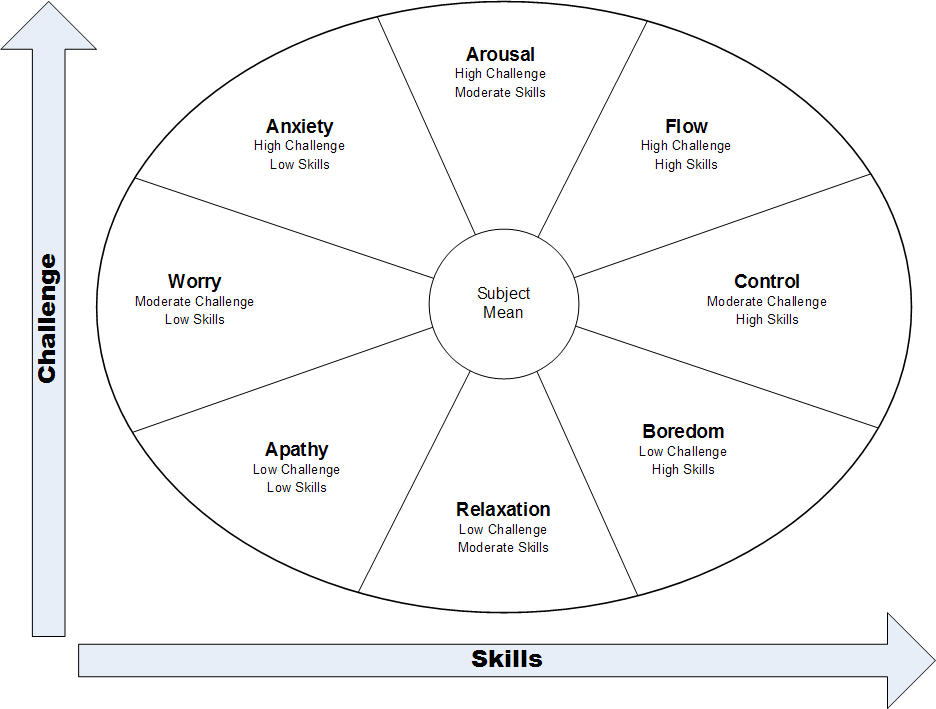
I believe “No Dust” can be correlated with Mihaly Csikszentmihalyi’s, theories on Flow. His chart is a brilliant tool, one that I often find myself pondering.

Flow is a mental state where high skill and high challenge is paired in time and space, the skill and the challenge evenly matched. Mihaly developed the idea with humans in mind; I have found it beautifully applicable to animals as well. “No Dust” could be considered the cowboy’s version of Flow, or Flow could be considered the psychotherapist’s version of “No Dust.” The reason to correlate them, is the chart Mihaly Csikszentmihalyi brings to us.

Each of us has our own perception of what our skills are. High or low in the chart is a measure of our self perception. It is applicable to anyone, in any circumstance. When it comes to finding the state of Flow, or getting in the Zone (as athletes have been know to call it), self confidence can be as much a factor as tangible skill.

“No Dust” could be considered the process of learning and developing in a state of Flow. The challenges faced match the level of self perceived skill. In this amazing state, you lose your sense of self, your sense of time, mastering the challenge at hand becomes it’s own reward. Skills expand and develop naturally without stress. This I believe is life at its best.

As you see from the chart, it isn’t an exact point, it is a range. Bump the challenge up a few notches higher and all of the sudden your skills don’t look quite so top notch in comparison to what you are facing. You find yourself in a state of excitement or arousal. Can you learn what you need to know and increase your skills enough to be successful?  This is fun; many live and breath for this state. What is life without the high? This is the state of accelerated learning.

Bump the challenge up higher, or knock down your sense of skill and all the sudden you find yourself in a state of Anxiety. Here the learning starts to shut down. The desperation for skill clouds judgment and logic. We start questioning why we would even want to face this challenge. We start looking for a way out. If we can persevere in this uncomfortable state, it sometimes yields a breakthrough learning experience.

You are getting the idea of the top half of the chart.

Now let’s go back to flow, and what happens when the challenge seems not quite so challenging, or our skill seems beyond the challenge. We then enter a state of control. We know what to do, and how to do it. There is a sense of achievement in doing it well. This is where habits are built. A calm and steady sense of accomplishment makes it feel worthwhile, even though our skills are not particularly developing.

Raise the skill a little higher, or lower the challenge and boredom starts to kick in. Here is where we start questioning why we would want to do this, and we start looking for a way out. If it is a challenge necessary to the quality of life, we hope we can persevere and develop a habit of accomplishing the task without much thought. Leaving our minds free to ponder the more interesting things life has to offer.

In horse training, we usually think in terms of carrots and sticks. Reward and punishment. As I am going to be beginning a project where the stick is left in the barn, and it will take a little while before a mustang even knows what a carrot is…. I have to think outside the box. Beyond carrots and sticks. I have to ask what other reasons there are that a  horse would choose to become my partner? I believe horses have the same desire to feel good that we do as humans. We all choose partners in life because we are social creatures, we feel better in company. I believe we feel better in company because we challenge each other. Our sense of self is expanded and developed because of how we inspire one another. What kind of partner will I need to be for my horse to cause him to choose my company, for reasons beyond reward and punishment? I believe the concept of “No Dust” is going to be important as I explore this.

Horses have a higher flight instinct than people, they are quicker to look for a way out when things get stressful or boring. We humans have confronted that problem simplistically with round pens and ropes to make sure they can’t get away. Once they can’t get away, we can train with as much dust as we want. Create a large disparity between what a horse knows how to do and what he must do and he has to learn a great deal quickly. His anxiety and worry will create dust and chaos as he tries to run, and finds he can’t. If he can’t escape, he will have to learn to cope with whatever challenges he faces.

Here is where I offer up my most sincere and humble apologies to all the horses I have hurried though the learning process. I had tasks I wanted to accomplish, a strong skill set I thought we needed to build together and never enough time. Pair that with my lifetime of riding horses, an over confident perception of my own skills, and young or green horses with lower confidence in their individual skills….  My desire for a state of Flow, to be in the Zone, or even the high of exceeding my known skills often led to pushing horses faster and harder than was optimal.

I believe, like an athlete building muscle, there is a certain amount of stress that can be productive in learning, but the more stress you put on something, the more recuperation time you have to allow for. In my history, I haven’t always made the time for both, and while I am proud of the relationships I have with my horses and what we have accomplished together, I feel I have seen the break down of confidence sometimes because I was in a hurry. In that hurry, training through the dust seemed the best and most exciting way to proceed.

As I turn over a new leaf here in 2011. I have entitled this blog Meditations on Equestrian Art. In a relationship, the skill set of both parties must be considered. So how do we place a horse and rider of different skill levels into that amazing state of flow together? How do we find that place where time disappears, learning happens with inexplicable ease, and the joy of the moment outweighs any possible future reward.

Within the art of meditation I believe is a possible answer. There is an entire world of introspective challenge that I can control for myself. My awareness of self can be my malleable playground keeping me firmly grounded in Flow, as I allow my horse to walk step by step through his developmental process. Where I might otherwise drift into boredom with his pace of learning, I can reach toward self-awareness, ever challenging myself to feel more deeply. We will learn our physical tasks together, while we grow as individuals side by side.

A relationship naturally seeks to combine the skill set of both partners. I now think this can be best developed if I pay close attention to the “Dust” or chaos, and respect it as a temporary lapse in partnership and a mismatch between skill sets. Perhaps a little “Dust” is just a catalyst that focuses us,  however, beyond a certain level I believe it is counter productive and tends to erode confidence and trust.

When I begin this project next year with a new horse, I will have the added incentive to be aware. If I create too much dust in THIS project, this horse will have the freedom to walk away. Training in flow, is the only way to go this time.

Elsa Sinclair

www.equineclarity.com

Here is some of a presentation I did in 2009, based on the ideas of training in Flow.