The horse who helped me understand, freedom of choice is not always the best choice; while also acknowledging, freedom of choice will always be my favorite choice.

In 2019 I was looking for a dangerous stallion to learn from. I thought my horse training skills were that good, and I needed a teacher beyond anyone else’s idea of reasonable.
Dangerous stallions were surprisingly hard to find. Following up on leads led to many responses of “If only you had called a month ago, we had to put him to sleep”, or “we gelded him and he is doing ok now.”
Finally, I found Atlas ready to ship across the border to Canada for slaughter, owned at that point by a dealer who was less than keen to sell him to me. “Likely from bucking stock, 8 years old, good looking and F****** dangerous.” He added “If I sell him to you, I will need you to sign something saying you are buying him against all recommendations, he really is a horse that should just go to slaughter.”

I brought Atlas home. It was one of the best decisions I ever made.
At the time, I thought I knew something about training horses. I thought I knew something about creating environments where freedom of choice led to healthy and happy horses, regardless of the odds against us. I thought a lot of things that I would find out were the most whisper faint outlines of a sketch of understanding.
Atlas was there to help me fill in the details. The details of learning I had no idea I needed.

By the time I got him home, the insides of the horse trailer were covered in snot. Gobs of mucus dripping off the ceiling, walls and coating the floor. The quarantine planned was indeed necessary and I had weeks of time observing from a distance as Atlas came back to health.
Once we were beginning to work closer together, we knew each other well enough to know that as long as Atlas wasn’t cornered, he wasn’t dangerous to me. Getting closer together though, was so much more difficult than I anticipated.

I believed in freedom of choice. It was up to me to prove getting closer was a good idea and if Atlas didn’t agree he could opt out. I still feel sure this was the starting point that gave us a basis of safety together.
Ari, a mustang stallion newly rounded up from Nevada joined us and I attempted to have Ari and Atlas live together. This was a beautiful idea for about two weeks, and then they started to fight for real.

Atlas had a supreme amount of freeze tendency in life. When he was stressed, all senses would shut down making that huge golden body stiff and still for sometimes hours. Ari couldn’t handle the lack of response in a herd mate, yet once he had forced Atlas from that freeze, he was not big enough or strong enough to win the fight he had just started, try as he might.
The injuries became bigger than I was willing to tolerate, so I separated Atlas again and this is where my training plan started to fall apart.
My training of horses in freedom had always existed in a herd structure, yet I had never given the herd enough credit for their part in my training.
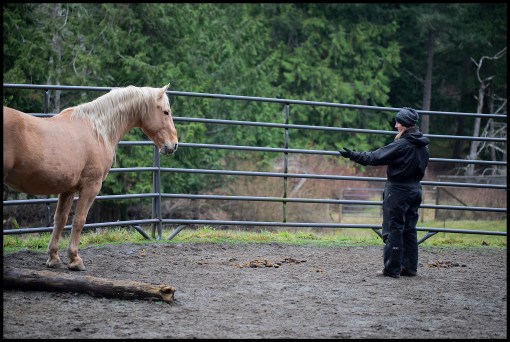
When I walk into a relationship with a horse using nothing but my own body (no food rewards, no trapping them between me and a fence, no ropes, no flags, no whips). I am banking on a horse’s herd instinct to build the relationship between us. Relationships are built of communication and response, horses communicate with the movements of their body (arcs, turns, parallel lines and intersecting lines). My body may be the wrong shape, but I find horses are generally fascinated by my attempts to join their conversation.

While most training methods focus on the types of pressure horses put on each other and use the appropriate tools in human hands to mimic pressure styles that make sense to a horse, I am coming at it from the other direction. If I have no tools of pressure, what would make a horse want to do things with me?
Before Atlas, I was supremely confident. As it turns out, Atlas was there to show me there were some details I didn’t know yet.
Within a herd structure, horses are generally big enough and strong enough to put pressure on each other when behavior needs to change. This is what Ari was trying to do for Atlas, but when I separated them over my fear of severe injuries, all Atlas and I had left was communication and untimely that wasn’t enough for him to find his own mental health out of his past trauma.
We tried for months using our arcs and turns and circles around each other with no tools and minimal pressure. The result was Atlas’s freeze responses to the world around him became deeper and deeper until from that place of unawareness, a bird flying overhead would so violently scare him that he would run and fall, scraping all the fur from his knees. I had stopped injuries between horses, but I could not stop Atlas from injuring himself.
I had introduced another herd mate quiet enough to not start fights with Atlas, that was better than being alone. However, I had no horses big enough and strong enough to push Atlas from his freeze in a herd environment. It was time I stepped in with some human tools, even though that was not my desire or my plan. Atlas’s health became more important than my wants.

Using a round pen fence as the source of pressure and my body in the right position I started a walking practice with Atlas. I wasn’t directly addressing the freeze when it happened (that would have been too dangerous). I was simply adding a certain number of miles to his day that would increase physical health, mental health and emotional resilience. It worked beautifully and that was as happy as it was sad for me. Atlas’ health was important, more important than my attachment to freedom of choice.
I watched the fear from every day normal events dissipate. I watched communication between Atlas, humans and horses improve. The walking practice was the most simple miracle I could add to our lives, and then I did too much.
Pressure on tension causes explosion. If you do anything for long enough tension will go up and there was a day I had Atlas walk for too long.
I do credit all the work I did around communication before I added pressure for the way we survived an event that shook me deeply. Atlas was walking, and I was following him. We had strayed away from the rail of the round pen and he decided I had pushed him for long enough. The way he turned to face me as he grew about ten feet tall, ears pinned and so still with every muscle poised to attack. I froze like a rabbit, and he held his threat strong towering over me. I really thought that was the day I was going to die, and I couldn’t move. This was what I had been warned about, this was the Atlas that came with the reputation of trying to kill people.
Then sweet Zohari, the warmblood gelding, who at that point had saved me from a million mistakes over a lifetime spent together, walked over to join us. Checking in with me, checking in with Atlas, defusing the moment and changing Atlas’ focus gently in a way only he could.
I left the pen shaking and sweating and glad to be alive. Nothing bad happened, but we had come closer than I ever wanted to again.
Atlas was the biggest gentle giant of a horse who wanted nothing more than to be peaceful, yet push him too far and he would show you how small and weak you were.

Over the next few years, I learned how to do an adaptable walking practice that brought Atlas a quality of life worth having. I also slowly and experimentally gave him more friends, though sometimes at the expense of their health when they poked him at the wrong time and lost a baseball sized hunk of flesh to his teeth, after he knocked them to the ground and pinned them there with his knees.
There were consequences when you didn’t know how to read Atas’ signs of pre-concern.
Ultimately this is what brought me to geld Atlas years later. His life was better with friends; his friends’ lives were not better with him. The depth of his emotional instability, tendency to freeze and then explode could potentially be softened with a little less testosterone running through his system.

After the gelding, Atlas was different immediately. Not something that is supposed to happen as it takes months for the testosterone to come down. I wonder now if perhaps the ketamine used in the gelding process had a stronger effect in resetting his nervous system than I could have guessed.
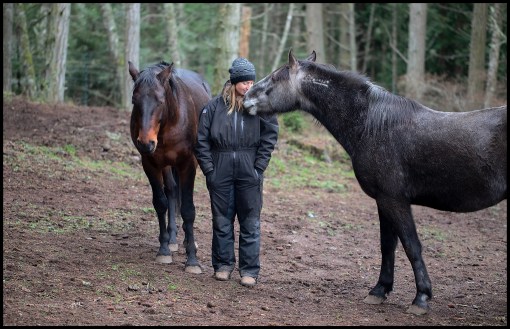
Regardless, as a gelding Atlas became the center of my herd and everyone’s best friend. A herd that did include Ari, my mustang stallion. Once Atlas was fully a member of the herd and had all the benefits of appropriate pressure that horses put on each other, it freed me up to settle back to the communication style of training I prefer.

I believe the conclusion Atlas has helped me come to is that pressure that exceeds freedom, is a gift to a horse when used in the right ways or times to shape their lives for the better. I would always prefer to have other horses contribute the necessary pressure in their lives while I get to play in the realm of freedom of choice.

If I do need to add pressure my preferred version of it is a walking practice. Mimicking the many miles, they might travel together in the wild. What that walking practice might look like is highly adaptable to the horse in question, as Atlas taught me.

If I had to bring it down to one point Atlas helped me learn, it would be adaptability. Have a plan, have a goal, seek health and well-being and constantly adapt the path to suit those traveling there together.
I said goodbye to Atlas this week. His many body injuries from times past finally grew too painful to keep him with me longer.
As his herd mates seemed to express over the last few years, I too, feel Atlas may be my favorite friend I have ever had.